Dear Fia, Why a range, and not a date?
Your cycleNote
Why Fia shows your next period as a range of days
Real cycles vary, so one date promises more than it can know. How Fia works out the days your next period could start on, and why the range changes.
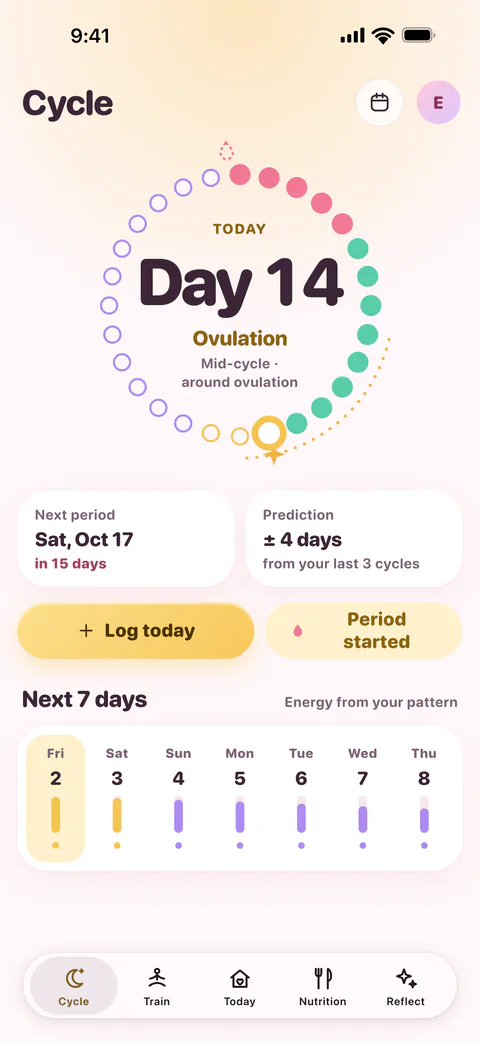
Most period trackers give you a date. Fia gives you the days your next period could start on, like “could be Oct 19 to 27”, and tells you what that’s based on. It still names the day in the middle, so you have both. Here’s why the range comes first.
Real cycles vary
The 28-day cycle is a textbook number, not a promise. Across more than 600,000 cycles logged in an app, the average cycle was 29.3 days. The days before ovulation averaged 16.9 but mostly fell anywhere from 10 to 30, while the days after it mostly fell between 7 and 17 Bull et al., 2019.
So most of the variation comes before ovulation, and it moves your next period with it. Even a careful average misses some months early and some late. A single date hides that, and a range shows it.
How Fia works it out
Fia works out your next period on your iPhone, from the periods you log. Nothing is sent anywhere to do it.
- Your most recent cycles count most, so a lasting change shows up within a few cycles.
- Until you’ve logged three cycles, it leans on the cycle length you gave it when you started, or on the 29-day average.
- The range starts wide and narrows as you log. With three logged cycles it’s about four days either side, and it’s never narrower than your own cycles vary.
- It’s wider for the period after next than for the next one, and Fia says which cycles it used.
Day 14: the next period around Saturday, October 17, give or take four days, from the last three cycles.
The fertile window is an estimate
Fia also estimates your fertile window, the days in a cycle when pregnancy is possible. It’s an estimate, never birth control. In one study, only about 30% of women had their fertile window entirely within days 10 to 17 of their cycle, and its timing was unpredictable even in regular cycles Wilcox et al., 2000.
In the US, software that sorts fertile days from the rest to prevent pregnancy is a regulated medical device FDA, 2018. Fia isn’t one, and doesn’t try to be: its estimate is there to help you understand your cycle.
On hormonal contraception
The combined pill works by keeping your ovaries from releasing an egg each month, so there’s no ovulation to predict NHS. If you use hormonal contraception, tell Fia, and it shows bleed days rather than cycle phases, with no fertile window estimate. You log a bleed the way you’d log a period.
When a range isn’t the question
A range can’t tell you why your cycles changed. If your periods often come at irregular times, or stop for more than three months and you’re not pregnant, talk to a doctor NHS, 2026 NHS, 2026.
Questions
How many periods should I log?
Log each period as it starts. The range narrows as you do: with three logged cycles, it’s about four days either side.
Why did my range get wider?
Usually because a recent cycle was shorter or longer than the ones before it. The range is never narrower than your own cycles vary, so when they vary more, it widens.
Can I use the fertile window to avoid pregnancy?
No. The fertile window is an estimate, never birth control. Talk with a doctor or a sexual health clinic about contraception.
Does Fia send my cycle anywhere to predict it?
No. Fia works it out on your iPhone. It has no account, and SideSwipe Labs has no server that holds your logs.