Dear Fia, Am I even doing this right?
KegelsHow-to
How to do a kegel, step by step
Find your pelvic floor, then lift, hold and let go. How to do a kegel well, how much to do, and when to see a pelvic health physical therapist first.
A kegel is an exercise for your pelvic floor: you lift and squeeze the muscles, hold them, then let them go completely. It sounds simple, and it’s easy to get wrong. In one study, after brief spoken instructions, only 49% of women squeezed the right way, and a quarter bore down instead of lifting Bump et al., 1991.
So technique comes first. Here’s how to find the muscles, how to do one kegel well, and when to check with someone before you start.
Find the muscles
Your pelvic floor is a layer of muscles across the base of your pelvis. To find it, sit or lie comfortably and imagine you’re holding in gas and stopping the flow of pee at the same time POGP, 2024. The lift and squeeze you feel is your pelvic floor.
Use that idea only to find the muscles, never as an exercise on the toilet.
While you lift, keep your belly, buttocks and thighs soft. If you can feel them tighten, ease off and try a smaller squeeze.
How to do one kegel
- Sit, stand or lie comfortably, and breathe normally.
- Breathe out as you lift: squeeze and draw your pelvic floor up and in.
- Hold the lift, and keep breathing. Never hold your breath.
- Let go completely, and feel the muscles drop back down.
- Rest before the next one.
Breathing out as you lift, then breathing normally through the hold, helps you lift rather than bear down, the mistake that study found Bump et al., 1991.
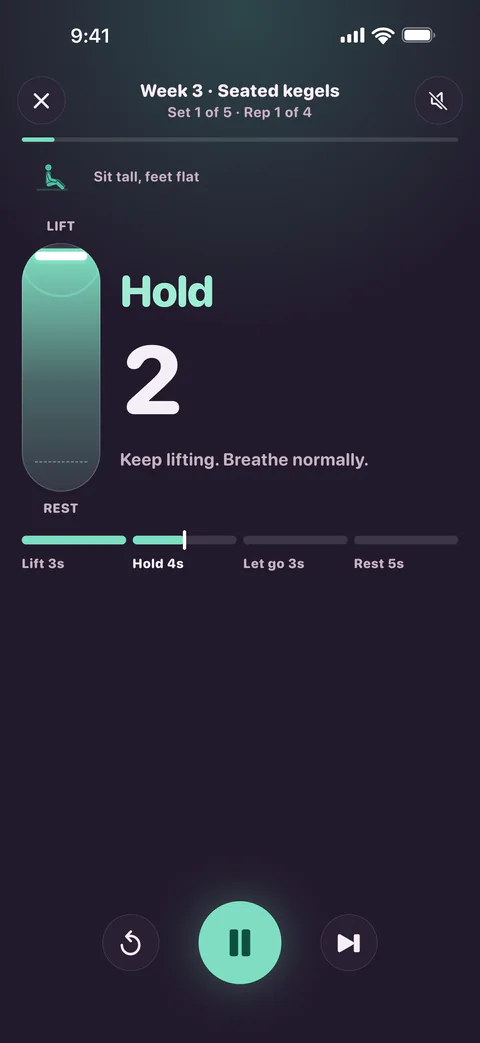
In Fia, each rep runs in four steps: lift, hold, let go and rest, with a timer for every second.
The let-go matters as much as the lift
Relaxing your pelvic floor fully after each squeeze is part of the exercise, not a break from it. A pelvic health physical therapist checks both your squeeze and your let-go for that reason NICE, 2021, and it’s why Fia gives the let-go a step and seconds of its own.
How much, and for how long
NICE’s guidance for pelvic floor training is at least 8 squeezes, 3 times a day, for at least 3 months, and to carry on if it helps NICE, 2019. It’s best with a pelvic health physical therapist, who checks your progress during the program and at its end NICE, 2021.
Fia’s journey starts at five minutes a day and grows to fifteen by week 12, with check-ins at the start, halfway and at the end.
Make it stick
Tie your kegels to something you already do every day. A plan like “after I brush my teeth, I’ll do my kegels” makes you more likely to follow through Gollwitzer and Sheeran, 2006. Fia reminds you at the time you choose.
Give it time. In one study, a new daily habit took 66 days on average to feel automatic, anywhere from 18 to 254, and missing a day didn’t undo the progress Lally et al., 2010.
Lift before you cough
Physical therapists teach a move called the Knack: lift your pelvic floor just before you cough, sneeze or pick something up, and keep it lifted until it’s over Miller et al., 1998 POGP, 2024. It’s the same lift, used at the moment the pressure comes, and Fia’s journey practices it.
When to see a pelvic health physical therapist
- You aren’t sure you’re doing it right.
- You feel heaviness or pain in your pelvis.
- You feel a bulge, or a push down, when you try to lift POGP, 2024.
- You’re pregnant, you’ve had a baby recently, or you have a health condition. Check before you start.
Questions
Can I do kegels anywhere?
Yes. You can do them sitting, standing or lying down, and no one can tell. Start wherever you feel the lift most easily.
Should I practice by stopping the flow when I pee?
No. Imagining it is only a way to find the muscles. Don’t do your kegels on the toilet.
What if a kegel hurts?
Stop, and see a pelvic health physical therapist. Pain can mean the muscles are tense rather than weak, and squeezing can make that worse St George's, 2025.
How does Fia guide a kegel?
A figure shows each lift, hold and let-go, a timer counts every second, and spoken cues are there if you want them. On Apple Watch, you feel a tap to lift and a tap to let go.